Tuesday, December 4, 2012
Theatrical Spin off of A Report to an Academy coming soon to new york.
A new production of a familiar Franz Kafka short story is being created and will premiere April 3rd 2013 in New York at the Baryshnikov Arts Center. It's title, "Kafka's Monkey" is a spinoff of "A Report to an Academy". We should definitely have a class field trip to see this.

Comment on Live performance of "The Metamorphosis"
I relieved enjoyed the live performance of the "The Metamorphosis" at the Brooklyn Academy of Music posted by Elijah. It's nice to finally get a visual perspective of Gregor Samsa in the story for once other than just in Crumb's cartoon illustrations. The affect of him climbing on the walls also is a great touch.
Scene from 'Metamorphosis' Live
Actor Gisli Orn Gardarsson narrates his performance of Franz Kafka’s novel, 'The Metamorphosis'. This show was presented at the Brooklyn Academy of Music by the Lyric Hammersmith of London and Vesturport Theater of Reykjavik. This is an interesting perspective to be heard.
Enjoy!
http://www.nytimes.com/interactive/2010/12/03/theater/20101203-metamorphosis.html?ref=reviews
Enjoy!
http://www.nytimes.com/interactive/2010/12/03/theater/20101203-metamorphosis.html?ref=reviews
I was reading this short fable by Kafka, and instantly thought of "The Metamorphosis". It is about a mouse who throughout his life, spent most of his days running around, admiring the size and vastness of the world around him. One day he realizes that the walls of great size are actually getting smaller, and therefore limits where he can run. The mouse soon runs into a corner and meets a Cat. This was his last encounter. Can we connect this to "The Metamorphosis" and how Gregor's job could be the walls growing smaller and smaller in his life and eventually leads to his final 'trap'?
Link below--
http://www.eastoftheweb.com/short-stories/UBooks/LittFabl.shtml
Link below--
http://www.eastoftheweb.com/short-stories/UBooks/LittFabl.shtml
Sunday, December 2, 2012
Saturday, December 1, 2012
"A Report for an Academy" and Life of Pi
I was reading Life of Pi and this part in chapter 4 that reminded me a lot of "A Report for an Academy". In the book, the boy, Pi, lives on a zoo. He talks about people that come to visit the zoo and say that when animals are in the wild they are "happy" and "free", and that they have all these ideas about wild animals like lions and cheetahs running on the savannah, hunting and eating happily, and looking after their family and young. All in all, they envision the animals with a happy life. However, Pi knows that none of that is true. All animals (including humans) are territorial and run completely on a schedule based on their surroundings (which they grow very accustom and attached to). Even in the zoo, when one little thing is changed, the animals react a odd ways. They certainly wouldn't be able to have a comfortable schedule in the wild, and in the zoo they get a care they need while still able to live in a semi-natural habitat (a man-made area that replicates their normal home). It reminded me of Red Peter and our conversation about freedom and a way out. It made me think 'if freedom really it's all cracked up to be?' Red Peter, while comfortable in his ignorance and freedom, knew that once he dabbled in education and human ways, he could never go back. The animals in Pi's zoo are similar. They may not be able to fully tell the difference between real freedom and zoo-freedom, but they have better care and healthier, safer lives.
Thursday, November 29, 2012
Kafka Quote

This is a quote from Kafka that I found. It reminded me of when we talked about how he didn't identify with being Jewish and he didn't really fit in or try to fit in, which could be him "following his most intense obsessions", in a way. It also made me think of his completely original and unusual writing themes. Stories about boys becoming men or things of the like that we have studied so far are rather common; it is not often that you read a novela about a man who turns into a giant bug, or a story about an ape that casually becomes a human. Kafka stands out and does not "edit his own soul". I think he is a great example of staying true to yourself and self-expression.
Kafka love at first sight
I found this interesting article today while searching for some Kafka topics, and it even brings another book, unknown to us, into play. Check it out
http://www.guardian.co.uk/books/2011/jan/15/john-banville-kafka-trial-rereading
http://www.guardian.co.uk/books/2011/jan/15/john-banville-kafka-trial-rereading
Wednesday, November 28, 2012
Kafka's Life
We all know Kafka to be a pretty weird guy who writes crazy stories about bugs and people starving for fun. That might have been the sole reason why he could't hold a relationship all his life! I found a cool article/biography about Kafka and on the fifth paragraph from the top, it talks about his relationships and then what he did with his writing.
Article
Article
Monday, November 26, 2012
"Kafkaesque"
We have our own ideas about what is "kafkaesque", but I wanted to look it up to see how it is defined by others and it is actually in the Merriam-Webster Dictionary. The dictionary defines kafkaesque as "of, relating to, or suggestive of Franz Kafka or his writings; especially : having nightmarishly complex, bizarre, or illogical quality." I just thought that summed up Kafka's voice and vision quite well.
Sunday, November 25, 2012
Kafka's Depression
I was reading another article which was just a biography of Kafka, but it really emphasized the sadness in his life immediately. In this first paragraph it spoke about his problems with his father as well as the death of his two siblings at very young ages. It was followed by the quote, "
A first sign of the beginning of understanding is the wish to die". This quote for me definitely gave me a better understanding with where Kafka was emotionally through his life.
If you want to look at the biography, here's the link: http://www.biography.com/people/franz-kafka-9359401
Kakfa Quotes
http://www.csmonitor.com/Books/2012/0703/Franz-Kafka-10-quotes-on-his-birthday/The-power-of-believing
I just thought these quotes were cool and some of them really reflect some of the aspects of Kafka we've been focusing on throughout reading his stories with tone and mood.
I just thought these quotes were cool and some of them really reflect some of the aspects of Kafka we've been focusing on throughout reading his stories with tone and mood.
Saturday, November 17, 2012
Identity
“This inescapable duty to observe oneself: if someone else is observing me, naturally I have to observe myself too; if none observe me, I have to observe myself all the closer” -Franz Kafka
I found this quote from Franz Kafka off of the website thinkexist.com.
I have been interested in Gregor's identity and how he really views himself. I was interested in if he views himself as a bug or a as the person he used to be. I think that it can be a combination of both and he sees himself as both bug and human. I think there are some context clues that point out that Gregor is somewhat confused on his identity.
I found this quote from Franz Kafka off of the website thinkexist.com.
I have been interested in Gregor's identity and how he really views himself. I was interested in if he views himself as a bug or a as the person he used to be. I think that it can be a combination of both and he sees himself as both bug and human. I think there are some context clues that point out that Gregor is somewhat confused on his identity.
Meowmorphosis
http://icanhas.cheezburger.com/tag/franz-kafka
I encourage all of you to watch this video of a MEOWmorphosis.
Wednesday, November 14, 2012
Here is a funny picture I found that relates back to the first chapter we read of "The Metamorphosis".
Funny Picture
Funny Picture
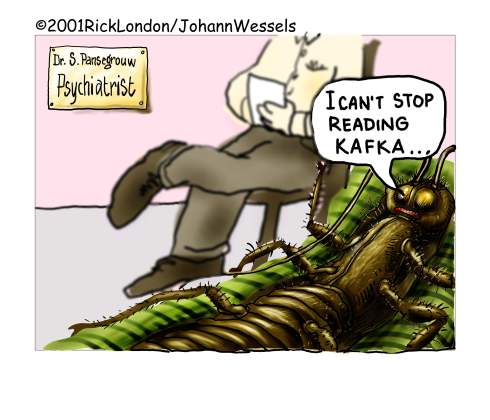
The Metamorphosis

Monday, November 12, 2012
Kafka and the Beauty and the Beast
I apologize for the fact that this document is incomplete (you have to buy it) but I read the preview and it seemed really interesting. http://www.jstor.org/discover/10.2307/27713629?uid=3739576&uid=2129&uid=2&uid=70&uid=4&uid=3739256&sid=21101429397777
Sunday, November 11, 2012
Thursday, November 8, 2012
Franz Kafka rock song from "Home Movies" on cartoon network
Found a funny song from Cartoon Newtwork's show on adult swim "Home Movies" about Franz Kafka.
Franz Kafka rock song
Subscribe to:
Comments (Atom)